|
60% Dependent on Exports! U.S. Slips to Third as Africa Takes Over: Tilapia Is Not Short of Buyers, but of Pricing Power
We are producing tilapia fillets and tilapia wgs. Large quantity, China origin Welcome to contact us for tilapia orders: sales@blueseafishery.cn Blue Sea Fishery Co., Ltd. Wechat: DORIS85789 E-mail: sales@blueseafishery.cn China tilapia fillets supplier/producer/packer, tilapia gutted and scaled(wgs) supplier/producer/packer/seller, frozen tilapia fillets, whole round, tilapia price 01 Industry Fundamentals: Exports Hit a Decade High, Yet Stuck in the Trap of "Volume Growth Without Price Growth"Over the past decade, China's total tilapia exports have fluctuated steadily between 400,000 and 520,000 tonnes, keeping the industry among the world's largest for a long time. However, "volume growth without price growth" has become its core dilemma. Reports show that national tilapia exports reached 518,000 tonnes in 2025, a new high in nearly ten years; yet total export value stood at only US$1.213 billion, down 12.1% year on year. The divergence between volume and price widened further in 2026: from January to August, total national exports hit 425,000 tonnes, up sharply 32.7% year on year, while export value was merely US$777 million, down 3.4% year on year instead. Unit export prices moved down simultaneously across the three major categories — whole frozen fish, frozen fillets, and deep-processed products — with overall declines generally ranging from 15% to 17%. Han Xuefeng pointed out that the core contradiction facing the industry today is not a lack of sales channels, but the long-standing absence of a say in international market pricing. Producers can only passively accept prices set by buyers; the larger the capacity, the thinner the profit, trapping the whole sector in a vicious cycle of "volume without profit." In terms of domestic industrial layout, the industry is highly concentrated. Guangdong, Hainan, and Fujian together account for 95% of national exports, with a clear division of differentiated roles: Guangdong ranks first nationwide thanks to its combined advantages in farming scale, processing capacity, and overseas channels; Hainan, leveraging free trade port policies, superior water quality and climate, focuses on high-value fillets and the high-end European market; Fujian, with mature foreign trade channels, deepens its presence in the African whole frozen fish market. Together, the three provinces underpin the foundation of China's tilapia exports. 02 Reshuffle of Export Structure: Africa Succeeds North America, Shifting from "One Dominant Player" to "Multiple Strong Markets"The trade war is thoroughly rewriting China's tilapia export market structure. Before the full outbreak of the trade war in 2024, the industry maintained a stable pattern of "North America leading, Africa following": the U.S. and Mexico together accounted for nearly half of total share, with the U.S. firmly holding the largest export destination and serving as the most important profit source; the African market contributed roughly 29%, mainly absorbing surplus whole frozen production capacity. Only two years later, the market rankings have shifted. Data from January to August 2026 show that Côte d'Ivoire in West Africa has jumped to become China's largest tilapia export destination, with imports over eight months already exceeding the full-year total of 2024; Mexico holds second place; the U.S. has slipped to third, ending its more than ten-year position as the top market. By regional block, the rise and fall of the four major markets are particularly notable: First, the North American block has shrunk sharply. The once-dominant North American market plunged from 49.8% in 2024 to 30.5%. From January to August 2026, China's tilapia exports to the U.S. totaled 61,600 tonnes, down 13.2% year on year; export value reached US$150 million, a steep 36.0% year-on-year drop, with the price decline far exceeding the volume decline. Second, the African block has risen strongly to become the primary growth pole. Its current export share has soared to 51.5%. Côte d'Ivoire, Burkina Faso, and Mali in West Africa form a stable "iron triangle," while emerging markets such as Cameroon, Senegal, and Benin have seen explosive order growth, serving as the core driver of export volume expansion. However, the African market absorbs mainly volume rather than value: 93% of orders are low-priced whole frozen fish at only US$1.29 per kg, less than half the U.S. market price, which can only digest capacity but contributes little profit. Third, the Latin American block acts as a "ballast stone." Centered on Mexico and others, the Latin American market has long held a share of around 20%, with order volatility and payment collection both stable. Mexico has taken over a large number of orders diverted from the U.S., becoming the second-largest export destination after Côte d'Ivoire, a stable market worth long-term cultivation. Fourth, Europe is an undervalued blue ocean of value. Between 2016 and 2025, China's tilapia exports to Europe grew cumulatively by 85%. Europe's product mix is far better than Africa's: fillets account for 38%, with unit price around US$2.50 per kg, nearly double the African level; it faces no additional tariff barriers, offers a stable policy environment, and leaves ample room for brand premium. Combined with the continued recovery of the Russian fillet market, Europe can fully serve as the core home base for domestic tilapia brands to build identities and enhance value. 03 Deep Dive into the U.S. Market: Orders Keep Draining Away, the Gap Is Taken Up by Southeast Asia and South AmericaChanges in the U.S. market are the focus of the entire industry. Starting from import and export data at both ends, Han Xuefeng analyzed the order-transfer paths under tariff shocks. From the Chinese export side, tilapia exports to the U.S. stood at 127,400 tonnes in 2024; they fell noticeably in 2025 under the dual pressure of higher tariffs and rising logistics costs, and dropped further to 61,600 tonnes in January–August 2026, with both volume and price weakening. From the U.S. import side, total global imports of frozen tilapia fillets by the U.S. in August 2026 alone were only 7,086 tonnes, down sharply 33.1% year on year; import value reached US$22.25 million, down 40.5% year on year, indicating a simultaneous contraction of overall domestic demand. Tariff barriers are the root cause of this situation. Chinese tilapia shipped to the U.S. now bears a combined top tax rate of 37.5%, stacked from base tariffs and Section 301 special tariffs; by contrast, Southeast Asian countries such as Vietnam, Thailand, and Indonesia face only 10%–12.5% tariffs, while South American nations like Ecuador and Brazil enjoy an even clearer tax advantage. This large cost gap directly pushes procurement orders to flow out continuously. The import gap left open in the U.S. market is mainly filled by two types of producing regions: first, Southeast Asia, where Indonesia, Vietnam, and Thailand have rapidly expanded farming and processing capacity, seizing frozen fillet orders with low-tariff advantages; among them, Indonesia has expanded the fastest, continuously squeezing China's space in the U.S. mid-to-low-end fillet market. Second, South American producing regions, where Brazil and Ecuador, leveraging geographic proximity and logistics cost advantages, supply whole frozen tilapia steadily and divert low-end raw material orders. Han Xuefeng judges that U.S. demand is unlikely to recover in the short term: on one hand, tariff barriers persist long-term, and policy uncertainty leads U.S. importers to generally shorten procurement cycles and refrain from placing large long-term orders; on the other hand, substitute categories such as pangasius keep eating into consumption share, and the ceiling on market demand continues to move lower. For domestic enterprises, the U.S. market has shifted from a "core profit market" to an "existing-stock maintenance market," and blind additional investment is no longer advisable. 04 Breaking Through in the Domestic Market: Grabbing the Structural Window of "Live to Processed" Amid the Volume CeilingFluctuations in foreign trade transmit quickly to the farming side, and the domestic circulation serves as an important support for the industry to hedge risks. Yet the domestic market also faces the reality of stalled overall volume and structural divergence. Data show that total national tilapia output in 2025 was about 1.9386 million tonnes, while domestic consumption reached 801,300 tonnes, accounting for only 41.33% of total output. Nearly 60% of production capacity must rely on exports and inventory digestion, giving the industry extremely high external dependence. Han Xuefeng notes that in terms of aggregate, domestic tilapia consumption has stayed stable at around 800,000 tonnes for three consecutive years, with limited room for overall volume growth; the greatest opportunity lies in internal structural switching: live consumption keeps declining, while processed consumption recovers steadily. Meanwhile, the domestic market shows extremely strong regional divergence. Guangdong, backed by local freshwater fish consumption traditions and a complete cold-chain logistics system, accounts for nearly 50% of national domestic sales. Hainan, constrained by cross-strait transport across the Qiongzhou Strait, faces live-fresh costs about 30% higher than inland, alongside persistently high losses, leaving domestic sales under 10%. Its frozen whole fish and fillets are also heavily homogenized with Guangdong's offerings, with little control over channels and branding; compounded by crowded competition in prepared dishes from competitors such as snakehead, sea bass, and pangasius, it is hard to replicate Guangdong's high-volume live-fresh sales model. Regarding domestic structural transformation, Han Xuefeng proposes a four-tier category strategy: live products target farm-gate direct supply to catering and retail channels; whole frozen goods supply group meals and canteen markets; fillets focus on ready-seasoned, marinated fillets entering household consumption; prepared dishes rely on branding to create fashionable ready-meal hit products. For the Hainan production region, it must break out of homogenized competition and pursue a differentiated domestic sales route. 05 Market Outlook: Short-Term Price Recovery, Long-Term Vigilance Against OverexpansionBased on frontline research covering farm-gate farming, fingerling stocking, orders, and inventories, Han Xuefeng puts forward two core judgments on industry trends in 2026–2027. In the short term, fish prices are expected to rise steadily with stability in the fourth quarter of 2026, and the raw-material inflection point has emerged. The industry remained sluggish in the first half of this year, with farm-gate purchase prices falling as low as RMB 3.5 per jin, and farmers losing RMB 0.6–0.8 per jin sold, leading to widespread losses across the sector. The depressed market directly dampened willingness to stock fingerlings. Frontline research shows this year's national tilapia fingerling release dropped by over 30% year on year, and the raw-material supply gap will extend into the first half of 2027. Signals of a price inflection point are now clear: farm-gate prices in Hainan have recovered to RMB 4.0 per jin, and major production areas in Guangdong have rebounded to RMB 4.25 per jin, with farming losses gradually narrowing. But because U.S. demand remains weak and Africa keeps pushing volume at low prices, upward price transmission faces strong resistance. Market strategy in the fourth quarter should be differentiated: high-quality raw materials should prioritize high-turnover orders from Africa, Latin America, and Europe; U.S.-bound business should focus on inventory digestion and channel maintenance, strictly controlling new capacity to avoid falling into low-price involution. In the long term, fingerling stocking will stop declining and rebound in 2027, and overheated restocking must be guarded against closely. Tilapia takes 4–6 months from stocking to harvest, meaning raw-material supply will remain tight and prices supported through the first half of 2027; supply loosening will appear no earlier than the second half of 2027. Han Xuefeng warns against farmers rushing to expand capacity in herd behavior once the market recovers, falling again into the cyclical loop of "market recovery → concentrated restocking → overcapacity → plummeting fish prices → widespread losses." The way out is to vigorously promote contract farming and long-term guaranteed-price purchase agreements: let downstream processing orders guide upstream production, arrange output according to sales, and shift the industry from "depending on the weather" to "order-based production." Han Xuefeng states that short-term fish prices may rise and fall, but prices will eventually return to value; overseas market maps keep changing, but the trade war cannot alter the long-term industrial value of tilapia. Although the industry is currently at a low ebb and facing multiple tests of market reshuffling and intensifying competition, as long as it stabilizes its diversified market layout, taps internal dividends from structural transformation, and lifts brand value and added product value externally, the sector will surely ride smoothly through this painful period.
|
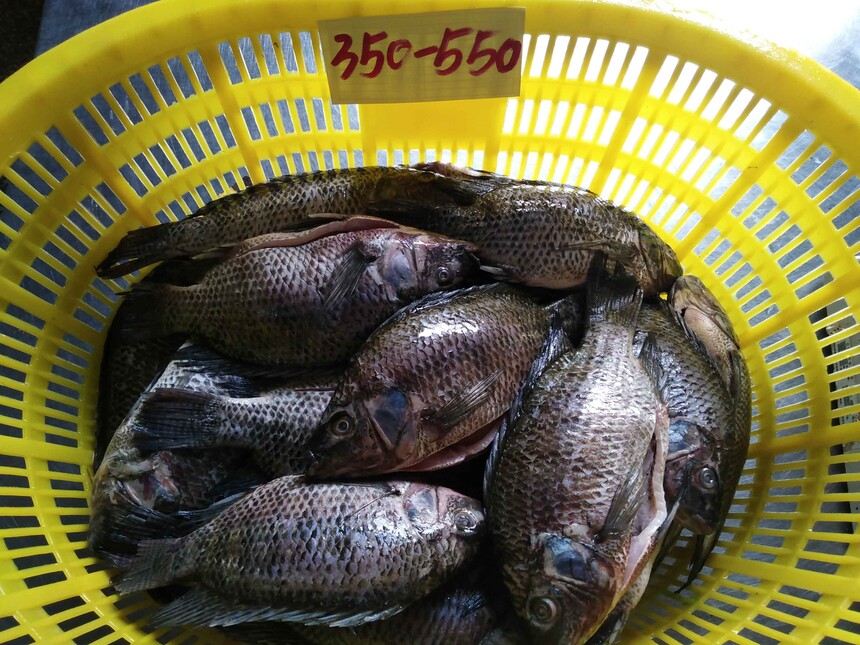 Tilapia wgs 350-550g(whole gutted and scaled), 100%net weight, China origin