|
Pacific Mackerel (Scomber japonicus) Fishing ConditionsTime:2026-11-10
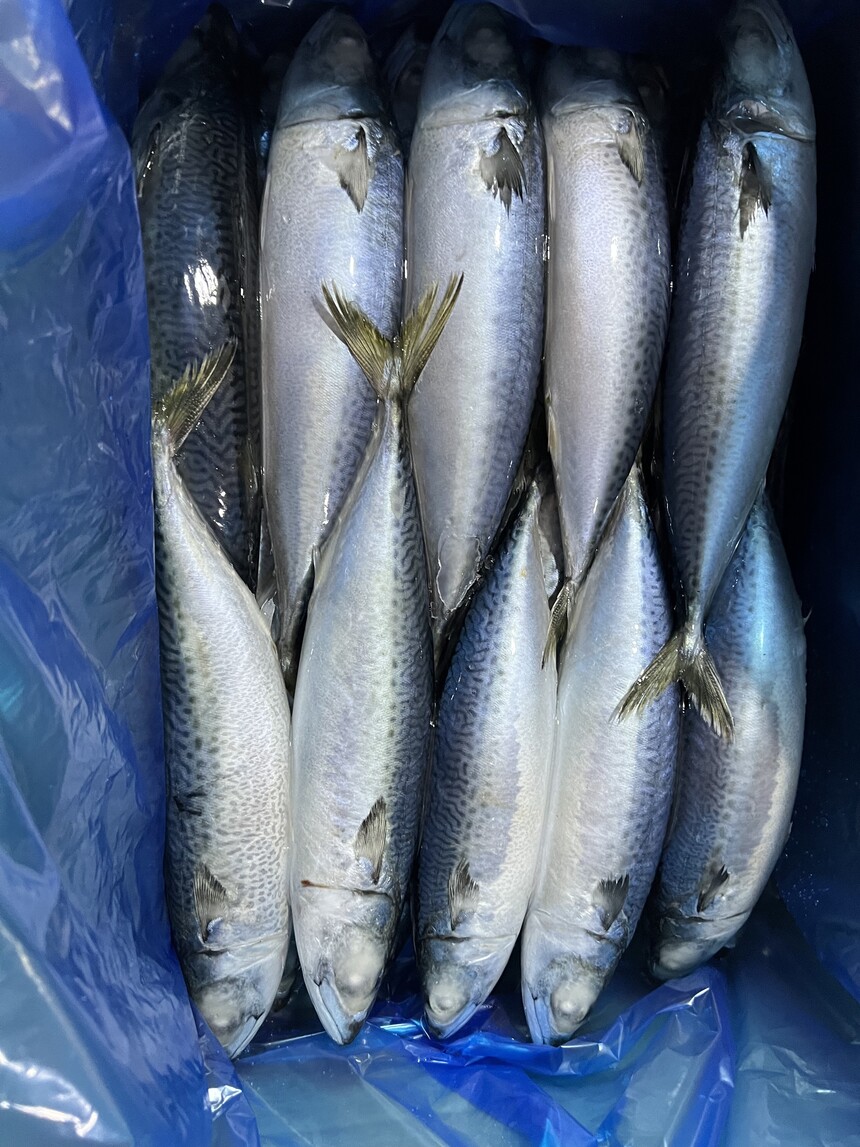
Frozen Pacific mackerel(scomber japonicus) available, 200-300, 300-500, 400-600g available, landfrozen/seafrozen. 10kgs-15kgs/carton. China origin.
Welcome to place orders with us: sales@blueseafishery.cn Blue Sea Fishery Co., Ltd. Wechat: DORIS85789 E-mail: sales@blueseafishery.cn
Pacific Mackerel (Scomber japonicus) Fishing Conditions 1. Resource layer: the fish really are fewer, and smaller Pacific mackerel (Scomber japonicus) has been falling sharply and continuously since 2018. The 2025 NPFC assessment confirmed that the age at maturity has advanced and weight at each age has declined, with SPRO (spawning stock per recruit) dropping to a historic low. This is not solely a result of "fishing too much": density dependence is also at work. After chub mackerel and sardine stocks expanded in tandem, competition for forage depressed growth and condition, so the fish landed are increasingly small and thin. 2. Fishing-conditions layer: El Niño "hides" the fish 2026 is a moderately strong El Niño (Niño3.4 at +1.2–1.5°C). The suitable-temperature belt in the Northwest Pacific has shifted northward, fish schools have dispersed and descended, and catchable density outside China's traditional fishing grounds has fallen. Spring-season landings are down 18%–22% year on year, with a further 10%–15% decline in summer and autumn, and the size structure has concentrated in the 200–300 g range. This is "cannot catch" rather than "not allowed to catch": the 2026 fishing-season high-seas quota is 47,940 tonnes, yet only 510 tonnes had been reported as of 30 September — 1.1% utilisation. The fleet is effectively acknowledging in practice that the fish are hard to find. 3. Trade layer: import substitution is tightening in parallel Norway's 2026 Atlantic mackerel quota is 81,375 tonnes, halved by 51% year on year, with its 71 purse-seiners averaging only about 600 tonnes each. Japan's domestic mackerel TAC has been cut by more than 70% versus 2024, and mackerel retail prices have tripled in five years. As a result, high-end substitutes (Norwegian and Japanese) cannot fill the gap, and demand is flowing back to Chinese and Korean product. 4. Outcome: prices already reflect scarcity, with clear divergence · Port side: At Dalian Longwangtang, pacific mackerel previously sold for RMB 1.4–1.8 per jin; this year the peak is RMB 4.2 per jin — nearly three times. · Export side: FOB for 300–500 g Pacific mackerel has risen from USD 1,650/tonne to USD 2,000–2,150/tonne (+16%), with the largest gains in large sizes; the 200–300g pacific mackerel increase is comparatively modest. · Structural feature: Scarcity is concentrated above 300 g. Small and medium sizes are not short of supply; what is missing is the premium large size suitable for sashimi-grade, whole-fish exports and canning. Hence the divergence: "total volume hasn't collapsed, but good fish can't be bought." 5. Outlook Scarcity is likely to persist into Q2 2027. First, the high-seas TAC has already been written into a downward path from 47,940 to 42,300 tonnes, and policy will not loosen. Second, ENSO will turn neutral at the earliest in early 2027, and the re-aggregation of fish schools lags by one to two fishing seasons. Third, Japan and Norway, the two substitute sources, are cutting production simultaneously. Genuine relief depends on the 2027 spring season: if recruitment is normal, 200–300 g will loosen first, while 300 g and above will remain tight. So price should keep rising before 2027.
China pacific mackerel supplier/producer(scomber japonicus), frozen mackerel packer/supplier/seller/producer
|